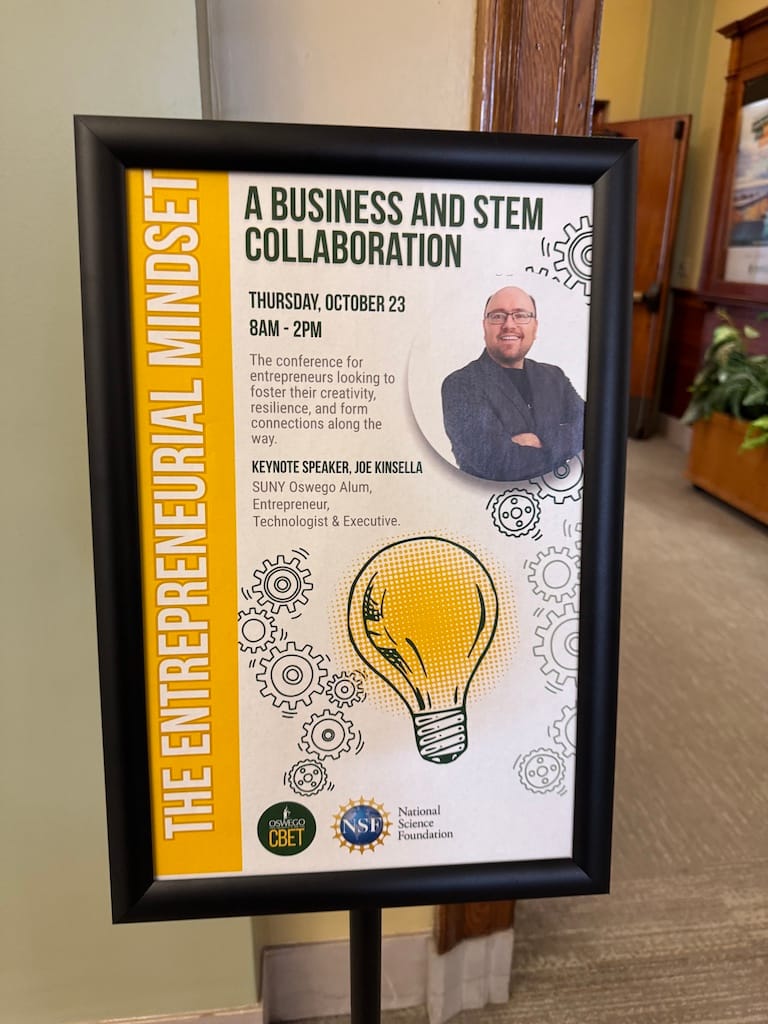
In October 2025, I came back to the State University of New York at Oswego to give a keynote for the kickoff of a new innovation conference. Since the audience included professors, students and industry professionals, myself and the dean of business struggled to find the right topic that would appeal to all. Eventually we came up with the idea of talking about the entrepreneurial mindset: the way of thinking - often exemplified by entrepreneurs - that has driven so much innovation in the world around us.
While at first I thought this topic would be an easy one for me, I quickly found myself struggling between balancing teaching versus storytelling. In the end I decided that since the best lessons come through stories, I would focus exclusively on the storytelling. Below is my keynote, with a transcript of my talk track. I hope you enjoy. 😃
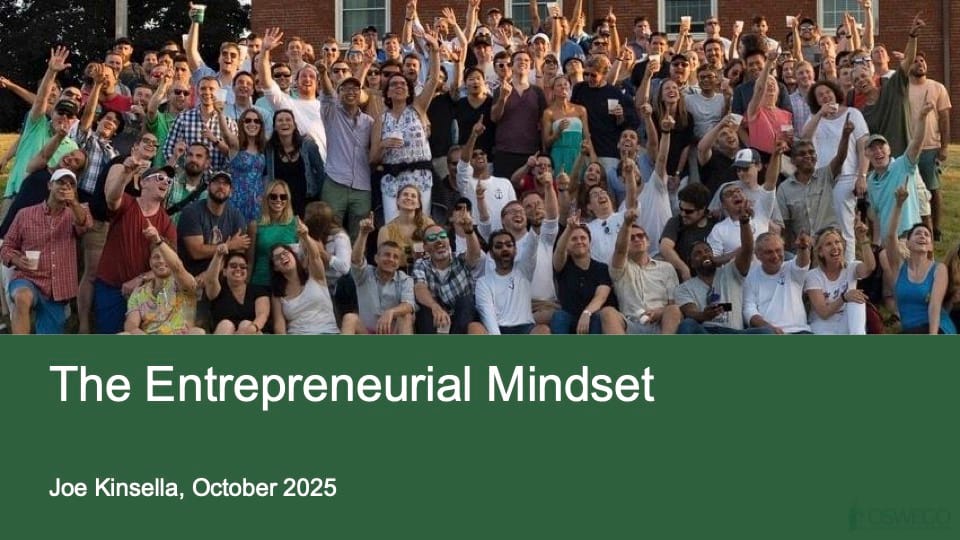
About Me
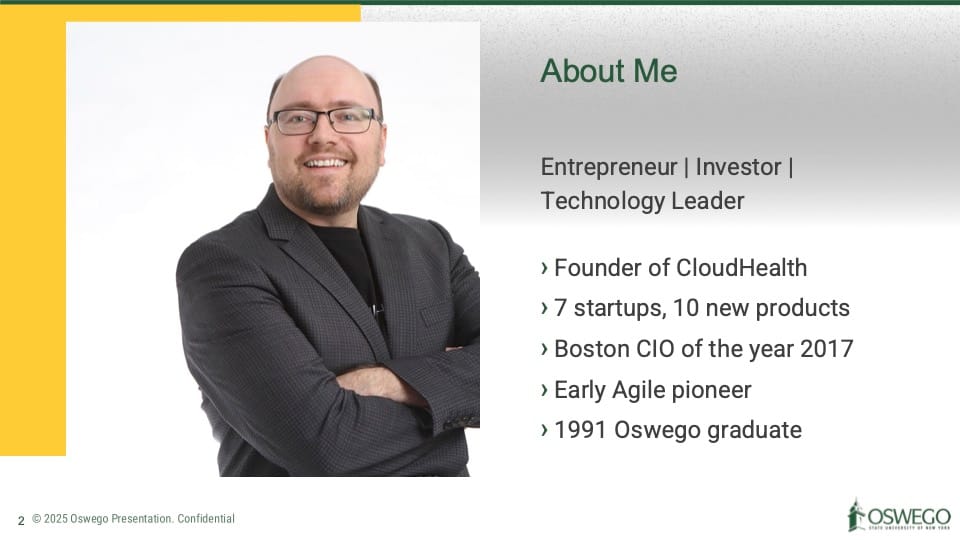
Thank you Dean Eichhorn for the introduction and the opportunity to speak here today. And welcome to all of you - faculty members, students and representatives from industry - who have taken time out of your busy week to join us in this conference. I was asked to speak with you today about a topic near and dear to my heart: entrepreneurship. Or more specifically: the entrepreneurial mindset. But before we go there, I think I should first confess to you that as an undergraduate at Oswego in the late 1980s and early 1990s, the interest in entrepreneurship was very far from my mind. I had much weightier things to think about then - such as what happy hour I was going to attend Friday afternoon; or how many layers of clothes are too many for my walk to class that morning; or how I was going to find enough time to finish yet another assignment due for Professor Mohammadi’s class next week.
But I also didn’t spend much time thinking about entrepreneurship because I already had a clear goal in life: to become a software engineer. This was an idea whose spark was lit when I used my first computer as a child, and then formalized right here at Oswego, as I learned from the experiences of my professors. The possibility of spending the rest of my life writing software - something I had been doing in my free time since I was a kid - seemed like a dream job. And so entrepreneurship was something that was definitely not planned for my life.
But life has a way of taking you down expected roads. After graduation I moved to Boston where I found that job as a software engineer. I did everything I could to be great at this job - learning from the more experienced engineers around me, and putting in long hours to perfect my skills. But then something strange happened: the better I became at writing software, the more my passion turned toward something larger: to building software products. And the more I learned about building software products, the more I wanted to build ones that solved new and interesting problems in new markets. And this would lead me to my first startup, where I experienced the incredible sense of mission that comes from an entrepreneurial venture - the creative freedom, the autonomy, the sense of urgency, and the ability to make an impact - and I was, in a word, hooked.
Over the next 30 years, I would be a part of seven startups, bring to market ten new software products, start two companies of my own, and experience three acquisitions by public companies. But I am best known in my industry - and most proud of - founding a company called CloudHealth Technologies, which I grew from a 1 to over an over 500 person business, delivering our products to over 8000 customers around the world, and eventually transforming the lives of our passionate team in selling the business in 2018.
I tell you all of this to make clear a simple fact: I was not special as an undergraduate at Oswego. I had a successful career in entrepreneurship because I had the privilege of learning a powerful way of thinking early - after which I decided to commit myself to and surrounding myself with talented people who thought the same way.
What Is Entrepreneurship / Intrepreneurship
We see entrepreneurship all around us, from the new coffee shop that started around the corner to the local professional - a doctor, lawyer or CPA - who opens an office down the road. We also see it at large scale, as we watch a new SpaceX rocket launch into orbit, or when we pull our smartphone out of our pocket to check in with family living hundreds or thousands of miles away. Entrepreneurship is the belief that one person, one idea, or one team can change the world. It’s the reason we live longer, learn faster, travel farther, and know more than any generation before us. Entrepreneurs have cured diseases, reinvented industries, and created opportunities where none existed. They’ve expanded our economy, yes - more importantly, they’ve expanded what’s possible. Every great leap forward in human history began the same way: with someone who refused to accept the world as it was, and instead decided to build the world as it could be.
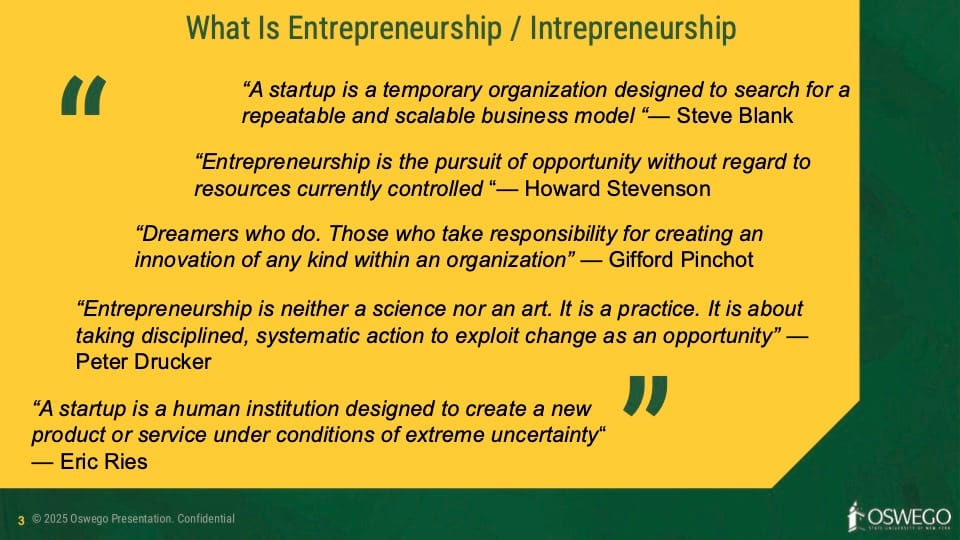
But if we are going to talk about the entrepreneurial mindset, we probably should start with a definition of entrepreneurship and its counterpart, intrepreneurship. Here are a few of my favorite definitions. From the Harvard Business School professor, Howard Stevenson, we have: “Entrepreneurship is the pursuit of opportunity without regard to resources currently controlled.” From the person who coined the phrase intrepreneur, we have: “Dreamers who do. Those who take responsibility for creating an innovation of any kind within an organization.” And maybe my favorite is from the Stanford professor, Steven Blank, whose writings opened my mind to a radically new way of thinking about entrepreneurship, we have the definition of a startup as: “... a temporary organization designed to search for a repeatable and scalable business model.”
If we read between the lines of each of these definitions, we can begin to see some common threads. These are: 1) the pursuit of an opportunity; 2) a willingness to take risks; 3) the ability to mobilize resources - even when confronted with constraints; and 4) the desire to drive some value in your organization or market or society.
What is an Entrepreneurial Mindset
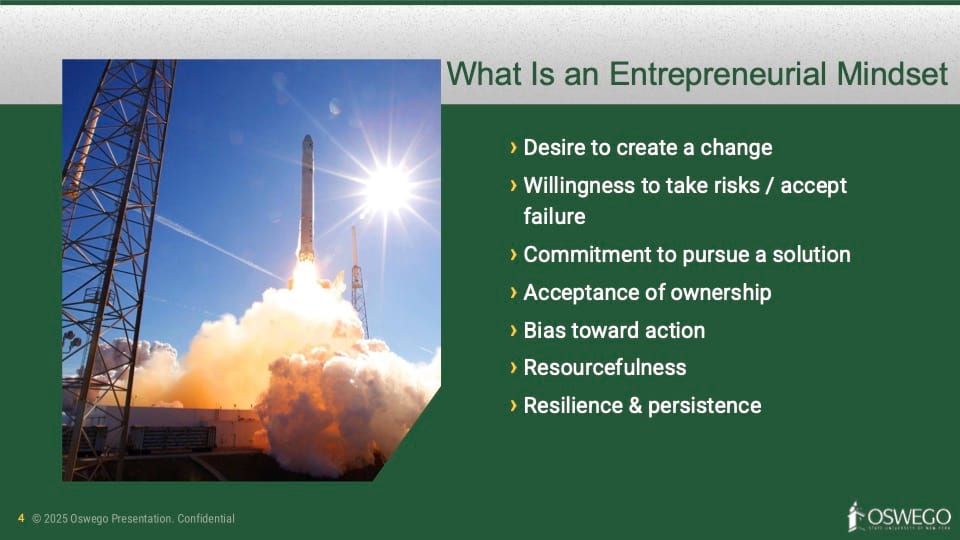
So what is an entrepreneurial mindset?
Many years ago I got into trouble on social media for a blog post. My post defined what I called “startup people” - people that had an entrepreneurial mindset. Where I went wrong was in ungraciously comparing startup people to non-entrepreneurial people working in large companies. The social media feedback was almost immediate, as employees from companies such as Google, Microsoft and Facebook told me how wrong I was to suggest that they didn’t have the same ability to manage risk or innovate or get things done.
If you’ll bear with me, I’d like to read a few lines of my transgression:
- Big company people value job titles and status. Startup people make up their own titles and know status is a byproduct of achievement.
- Big company people do what their teams are directed to do. Startup people do what is required to build a business.
- Big company people talk to product managers. Startup people talk to customers.
- Big company people value compensation. Startup people value opportunity.
- Big company people value process. Startup people value results.
- Big company people work to eliminate risks. Startup people accept that they are surrounded on all sides by risks simply by coming to work in the morning.
- Big company people can stay within a comfort zone. Startup people vaguely remember they once had a comfort zone.
- Big company people come to work to do a job. Startup people come to work to build a business.
And here might have been my single most offensive line:
- Big company people can hide their lack of performance for months or years. Startup people who don't perform will quickly find themselves working at big companies.
I still blush a little when re-reading this post, and feel the need to call out for everyone in the audience working at big companies: I most definitely exaggerated for effect. Now in my defense, I’d like to say that Professor Leah of the computer science department at Oswego shares some of the blame here - since as my freshman year advisor, he suggested I add a creative writing minor to go with my computer science major. The result of this advice has been that I not only know how to write software, but to also publicly talk about it, even when I know I shouldn’t.
But behind this post is something I do feel deeply in my heart and is relevant to us here today: that there exists a way of thinking - one that can be learned and applied by any of us - that can bring great change to our organizations, our communities, our industries, and society. It can be done in small or large organizations, and in new or existing ones.
I can distill this mindset for you in seven simple bullets. It starts with a desire to create a change - although maybe I should call this a passion to create a change. It is followed by a willingness to take risks that might - or maybe often - will result in failure, personally or professionally. It is followed by the commitment to pursuing a solution for that change - often obsessively - knowing that the burden rests entirely on your shoulders. And then there is always a bias toward action - which means not waiting for direction or permission, and instead making decisions, executing and adapting even if all the data you need is not available. And all of this is only possible if you can be creative with resources - since you almost never have everything you need to drive the change you want in your world. And finally, we have resilience, since driving a real change often means failing many times, in hope that you might succeed for a few.
Today I’d like to talk with you about four of the traits of an entrepreneurial mindset. To do this, I am going to tell you my personal experiences in applying each trait at my last company - and to hopefully give you some insights and thoughts on how you might be able to bring them into your work.
Willingness to Take Risks & Accept Failure
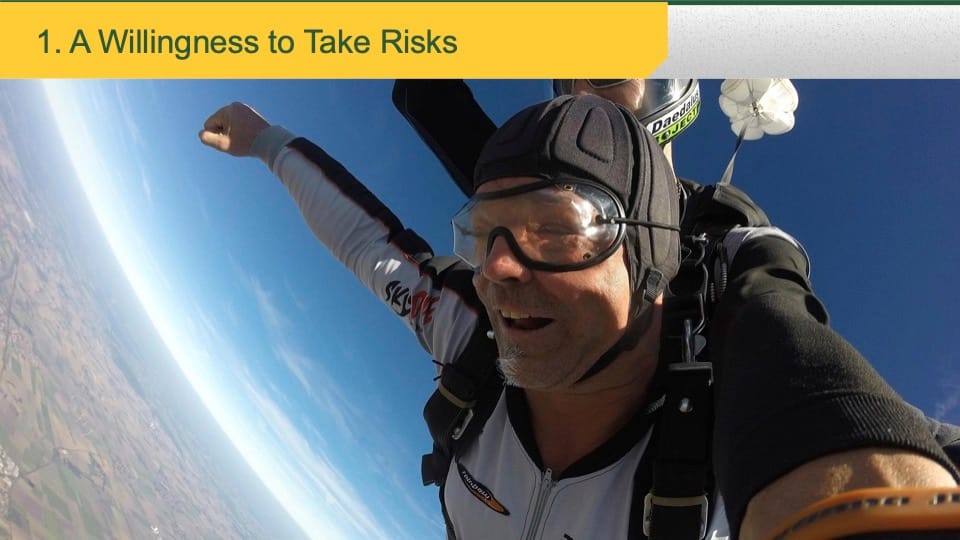
Taking risks is at the heart of every meaningful achievement, in business and in life. Progress never begins with certainty - it begins with someone willing to take a leap into the unknown. Every startup I’ve been a part of began the same way: with a leap. The idea wasn’t perfect, the timing wasn’t ideal, and the odds weren’t always great - but unfortunately progress never waits for perfect conditions. Instead it rewards those willing to act before the path is clear.
Now the cost of not taking risks is rarely visible in the moment. Playing it safe can feel comfortable - even responsible at times - but unfortunately it quietly limits what is possible in our lives, our organizations, and our communities. When we avoid risk, we trade potential for predictability, creativity for caution, and growth for familiarity. I’ve seen talented people and companies stall not because they made the wrong bet - but because they stopped being willing to bet at all. The world almost always moves forward because someone dares to take a risk.
Now I first had the idea for my last company, CloudHealth, in 2010. I had been watching the emergence of cloud computing and realized that it was going to be like a tsunami wave that would sweep across all industries, fundamentally changing how we built, operated and used software applications and infrastructure. I also knew that it would create big challenges to be solved in my area of professional expertise: IT management. And so I came up with what I thought was a great idea: to build a new product to help companies grow and scale using the cloud. In my excitement, I went out to talk to people I knew in the industry - venture capitalists, CEOs, CIOs, VPs of engineering - to see if they too were excited about my idea. But the response I got back surprised me. Almost universally, everyone thought I had a “really really bad idea.” Some thought I was wrong that cloud computing was going to be widely adopted. Others thought the problems I proposed solving were not big enough to justify building a new product and business. And yet others were convinced that even if the cloud was widely used, the vendors delivering it - big companies like Amazon, Google, Microsoft - would be the ones to solve these problems.
And so instead of starting a company, I took a VP of engineering job at a Boston startup that had bet its entire business model on the cloud. This startup was using it at a scale that was highly unusual for a small startup at this time. In my first month on my new job, I received a bill from our cloud provider Amazon, for $35K. I honestly didn’t think much of this until the second month, the bill had risen to $100K. And by the third, I was shocked to find it was over $180K. I did some quick back of the napkin calculations and concluded that if we didn’t either stop using the cloud, or find a radically different way to use it, our business model would not be financially viable - and we would almost certainly be out of business within eighteen months.
And so I set about solving the problem in any way I could. I wrote scripts to pull raw data into spreadsheets, where I built complex models to analyze and understand how and why we were using the cloud. I worked with my team to drive changes to how we architected, designed and operated our software. I even wrote an internal software application to help everyone see our use of the cloud in real-time.
After months of hard work, I stepped back and re-ran my calculations. To my happy surprise, the work we had done had not only fundamentally changed the economics of running our business in the cloud - but we found ways to make our service more cost effective than our competitors who were not using the cloud. In other words, we had transformed our decision to use the cloud from a liability, into a competitive advantage.
After celebrating the achievement, I stepped back to think about what I’d learned. Everything we had done had only validated the business idea I’d been told a year earlier was a “really really bad idea.” I also knew if I was right that cloud computing would be like a tsunami wave, there would be thousands of people just like me - CIOs, CFOs, VPs of engineers, VPs operations - who would need to solve these exact same problems. And so I started talking with my wife about the idea of starting a company. I knew the timing couldn’t have been worse for us: we had two boys in elementary school, I was the sole income for our family, and we had a mortgage that needed paying every month. I also worried about the risk to my career, knowing that going down this path, I was exposing myself to the potential of a very public professional failure.
But the more we talked about it, the more we were convinced that this might be a risk worth taking. And so I went back out to talk to many of the same colleagues who told me I had a “really really bad” idea the previous year. The feedback I received, which again was almost universal, was that instead of having a “really really bad idea”, I had just a “bad idea.” Now maybe it was my recent experience of being my own first customer of the product I wanted to build - or maybe it was all the conversations with my wife about the downsides of not taking a risk - but when I heard that my trusted colleagues go from thinking I had a “really really bad” to just a “bad idea” - I couldn’t help but think: progress.
And so it was in 2012, I quit my job to go on a journey to see if I could build a product and a business at the intersection of my two professional passions: IT management and cloud computing. For many months, my family lived off our savings, while I burned cash trying to pursue my passion. But while I knew I was taking a risk, it somehow no longer felt like a scary risk.
Progress never begins with certainty - it begins with someone willing to step into the unknown
Tips for Taking Risks & Accepting Failure
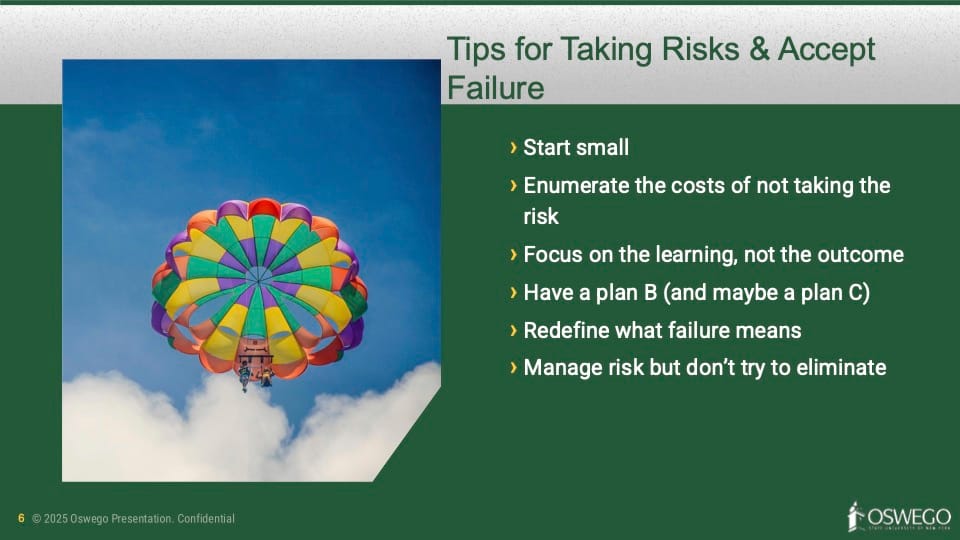
I like to think that if failure creates wisdom, I have acquired a lot of wisdom over my professional career. The most impactful lessons I’ve learned have almost always come from making mistakes. And so I’d like to share with you a few tips I learned the hard way when it comes to taking risks and accepting failure.
The first, and maybe the most important, is to start small. While I wanted to build a company and business when I quit my job, instead I committed myself to testing the idea through experimentation. I was able to do this because I had - with the support of my spouse - thought deeply about the opportunity cost of not making this leap. And when I started, I started small, focused on the learning - what is called in Lean Startup thinking validated learning. I also took the time to define a plan B that I hoped I would never have to use. Mine was to pick myself up off the floor after failure and to go out and get a job in someone else’s startup. I also took the time to redefine failure. For example, I convinced myself that even if I did fail, I would walk away with valuable skills and experiences that would make me better able to seize the next opportunity.
The last tip - manage risk, don’t try to eliminate it - was best explained for me by a business book called The Intelligent Entrepreneur, which followed the story of three graduates from the 1998 class at Harvard Business School. This was a particularly interesting graduating class from HBS because the classes that came before them had the benefit of working for several years in the highly profitable economic event known as the Dotcom Boom - whereas the class of 1998 would experience the severe downturn known as the Dotcom Bust within a few short years. The author did a great job explaining how while each of the three entrepreneurs knew they were taking risks, they didn’t feel like it was a risk any more because they had done everything possible to minimize and manage risks before making the leap.
Is there a risk that you are not willing to take? That is holding you back from driving a change you want in your world? If yes, now is a great time to think about that risk, why you haven’t taken it - and what the cost might be for you, your family, your organization, your community - for staying on the sideline.
Commitment To Pursue a Solution
Every great entrepreneur I’ve known shares one defining trait: an unwavering commitment to solving a problem that matters. Ideas are everywhere. It is almost always the willingness to commit to solving the problem - to push through the uncertainty and the setbacks - that separates those who drive great change from those who watch from the sidelines. Commitment is what transforms an idea into a solution, and a solution into change. It’s what keeps you believing even when success is elusive. In the end, the difference between those who dream and those who build, is that builders stay committed, even after the excitement fades.
Now I had the good fortune before leaving my job in 2012 of having been inspired by the writings of the Silicon Valley entrepreneur and Stanford professor, Steven Blank. His classnotes, which he published in a 2005 book called The Four Steps to the Epiphany, were a bit of a lightning bolt for me. He challenged everything I thought I knew about entrepreneurship by showing me how one could take an iterative, test-driven approach to pursuing a solution - a sort of scientific method for entrepreneurship.
Now the approach to entrepreneurship that was popular when I started my career was to have an idea, build it, launch it, and hope customers cared. It was sort of the “if you build it they will come” approach - and unfortunately, more often than not, they didn’t come. The modern approach - best exemplified by the writings of Steven Blank and Lean Startup and the ISC 484 course taught right here on campus - is to start small, define critical hypotheses, and run experiments until over time, you know exactly what to build.
While there are many great examples of using this approach, one of my favorites is the story of the AirBnB founders, Brian Chesby and Joe Gebbia, who started not by building a full featured service that listed houses and apartments for rent. Instead they put a few air mattresses on their living room floor, built a web page to allow people to book one for $80, and then promoted this page to attendees of a conference coming to town. This particular type of experiment - called a Minimum Viable Product or MVP - involves creating the smallest slice of your solution that can deliver real value to real customers.
In 2012, I was deep down this path of defining hypotheses and running experiments. By October I had built a simple Minimum Viable Product - a crude application. The critical hypothesis I wanted to test next was whether or not a full featured version of a product could ever be sold for $50K per year. I chose the number $50K not at random, but because through previous experiments, I learned that this was the price point I would need to be at to build a successful business model around my idea.
And so I designed an experiment called The Sale. The idea was to find prospective customers who had my problem, and set up a sales call on which I would try to sell them my crude Minimum Viable Product for $50K. Now I knew my MVP was not worth $500, much less $50K, so the idea of the experiment was to get rejected, after which I hoped to have a great conversation with prospective customers about what they needed to see in order to spend $50K.
I managed to find my first target customer - a fast growing startup in Utah making an e-learning product - and I managed to get a meeting with the CFO. I like to call this meeting the “worst sales call of my life.” While I think the CFO understood at a high level what I was proposing, he wasn’t close enough to the problem to give me any real feedback - and his idea of a good business deal was that instead of buying my product for $50K, I should give it to him for free. But as I started to wrap up the meeting, the CFO did something I didn’t expect: he offered to arrange a call the next day with their VP of engineering. While I had low expectations in another call, I accepted his offer, and arrived the next day determined to repeat my experiment.
But as I started to show the crude MVP I had built, I knew immediately that something was different. On the other side of this call were five or six people who not only deeply understood the problem I was trying to solve, but they had clearly spent much of their own time trying to solve it for their company. It was such a great call that by its end, I had completely forgotten about the experiment of asking them for $50K. Instead I tried to close out the meeting, energized by having finally found some real validation for my idea.
But after the third time I tried unsuccessfully to close out the call, there was a long and awkward silence on the other end, after which the VP of engineering said: “Sure, we’ll buy it.” This was particularly confusing to me because I had not actually asked them to buy. So of course I did what any good engineer would do when confronted with a sale: I tried to talk them out of it. “I spoke to your CFO yesterday,” I said, “and he said you weren’t interested.” Again there was a long and awkward silence, followed by the response: “Steve is in the room with us right now. He says we can buy.” You would think I would at this point have just accepted the win, but I was a man on a mission: So I responded with the one thing I knew that would shut them down: “It costs $50K,” I said. Again, awkward silence, after which the VP of engineering said: “Sounds good. Send over the contract.”
With that, I finally took the hint, ended the meeting, and scrambled to find a sample contract online that I could send over to be signed. Somehow, after months of pursuing the scientific method for entrepreneurship - of facing frustration and failure - my relentless pursuit of a solution allowed me to sign my first paying customer.
As a footnote to this story, every year for the life of my startup as a private company, employees of this company would join me and my team for a dinner at a conference in Las Vegas to celebrate our partnership - and of course to get a good laugh over the retelling of how it all began.
Tips for Pursuing a Solution
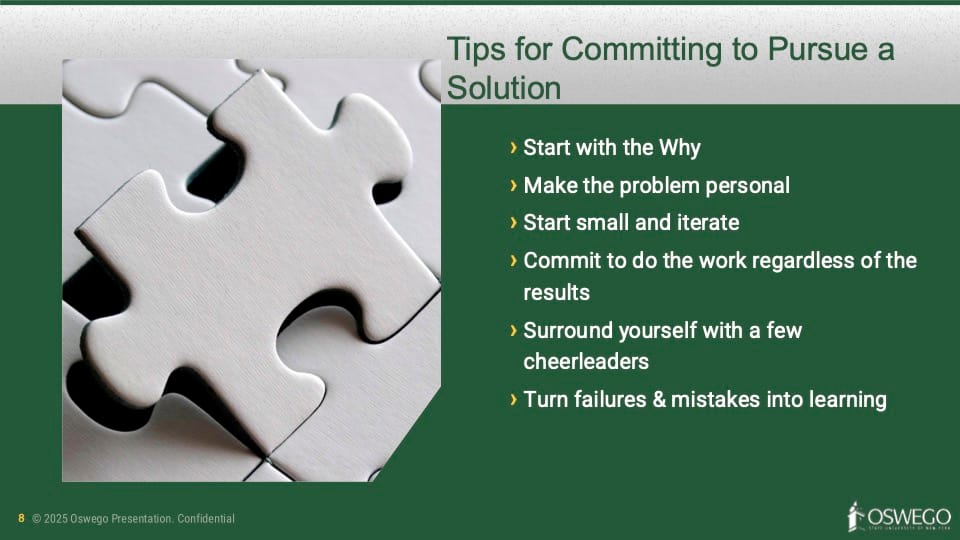
Here are a few of the tips that have worked for me over the years in my pursuit of a solution.
First, start with the why. An author by the name of Simon Sinek wrote a book that influenced me called Start With Why. In it he explains how inspirational leaders almost always start with the “why” rather than the “what” or the “how.” This allows the people around them to connect with the problems they are solving at a deep and emotional level. For me, the “why” was clear: to help future customers who, like me, would need help with the challenges that come from scaling in the cloud. This problem was of course deeply personal since I had been the first customer of the problem I wanted to solve - even cobbling together a partial solution through hard work and sweat equity.
To pursue the solution, I started small: by running a first experiment. This was the first of a series of iterative steps I would take over the coming, each taking me one puzzle piece closer toward proving or disproving my idea. In doing this, I had good days and bad days - to be honest, many more bad days than good - but no matter what happened, I always made sure to show up every day to push the ball forward.
One of the best early moves I made was to surround myself with a few well chosen cheerleaders. I called them my board of advisors, and they were colleagues and friends that had different experiences and skills from me, but shared one common goal: to see me succeed. Throughout those early months, I would regularly sit down with them individually to openly share everything I’d done since the last time we talked. And then I would sit back and listen as they gave me valuable advice and encouragement.
And finally, I focused on the learning over results, knowing that with each step forward or back, I was gaining critical expertise in both my problem and its potential solution.
Resourcefulness
Resourcefulness is the quiet superpower of every successful entrepreneur. It’s what you rely on when the plan falls apart, the budget runs out, or the people you need to do the work are not available. It’s the ability to do more with less - to see possibilities where others see limitations. The most innovative solutions I’ve seen in my career didn’t come from abundance - but from scarcity - from people who refused to let “a lack of resources” be the reason for not moving forward.
By 2014, I had managed to close a few customers, raise a first round of venture capital, and hired some early employees to help me build the business. I’d raised the capital by convincing my investors that we had achieved what is called Product Market Fit: the moment in the life of a new product or service when it can be marketed, sold and delivered to customers with some predictable level of success. Unfortunately, not long after taking the money and hiring the employees, we found that instead of regularly closing $50K deals, we were lucky to be able to close a few $500 ones. We were in a phrase: not at Product Market Fit. And so we scrambled, rapidly burning our precious capital while desperately searching for a way through this challenge.
One day I was asked to go to lunch with one of my early customers - a CIO at a tech company. I assumed the purpose of this lunch would be to get feedback on my product and maybe walk away with a feature suggestion or two. But after getting settled at the restaurant and ordering lunch, the CIO proceeded to tell me in what seemed like exhaustive detail, all the ways in which my product was not living up to his expectations.
As anyone who has ever taken pride in creating something knows, there are few worse feelings than that sense of failure, unworthiness, and rejection that comes with someone you trust telling you that you’re not living up to their expectations. I listened intently, trying to understand every detail in spite of my feelings of dejection. When he finished, my first instinct was to crawl under that table and feel sorry for myself. But instead I asked: “Would you be willing to work with me to solve this?” I can still remember the confused look he gave me, as though my question made no sense. “Of course,” he said. “Why do you think I am telling you this?”
After leaving lunch, I called my team back at the office and gave them the blow by blow of the conversation - including raw thoughts on how we might address the issues. I then drove back to my office, expecting I’d need to motivate everyone after giving them such negative news. But instead I arrived to find everyone assembled around a white board, enthusiastically rearranging paper mockups of the new features we could build to solve the problems.
Within a couple days, we had defined the requirements for a major new feature. Within the two weeks, we built and delivered a minimal version of this feature, which we put in front of the CIO for feedback, and then started to review with our other customers. Within four weeks, we had delivered a full version of this feature to all our customers. And within six weeks of that lunch, the CIO was so excited that he pulled all the leaders of his company together for a meeting to demonstrate, train and roll out our product across all departments.
The change in our business was almost immediate. Not only had we turned this CIO from being an unhappy customer to a champion, but we almost immediately received a universally positive response from other customers. That next month, our sales suddenly grew in a way we had not seen before. Within a few months, we were seeing the up and to the right revenue charts that every venture investor looks for in their portfolio companies. At that point I knew we had achieved Product Market Fit, and it was no longer a question of whether we could build a business around my idea - it was a question of how big a business we could build.
I owed this all to a customer willing to give me the bad news, a small team motivated to come up with creative solutions, and a commitment by all of us to not let our constraints prevent us from finding a path forward.
Tips for Resourcefulness
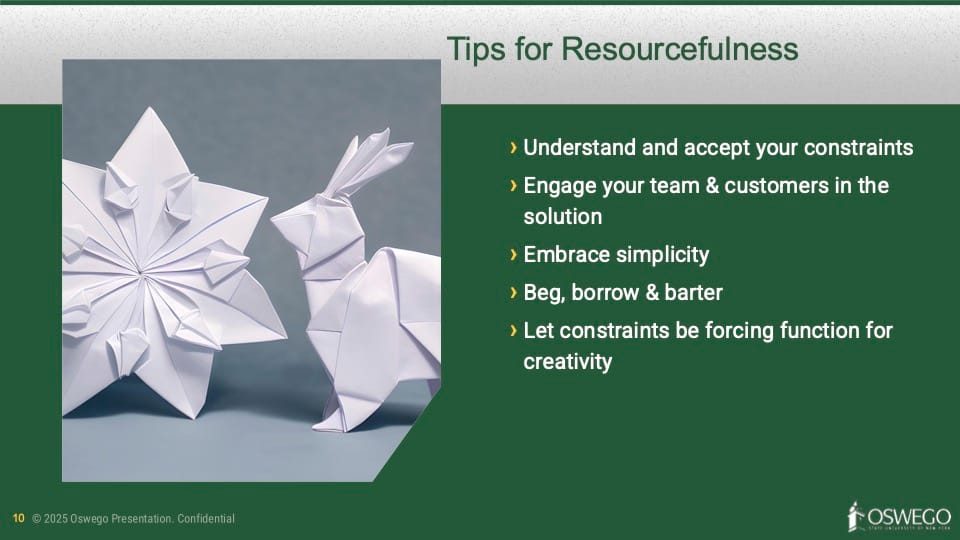
Here are a few tips I use when it comes to resourcefulness.
For me it starts with understanding and accepting my constraints. When the CIO told me my product wasn’t living up to expectations, I knew I had both a time and a resource constraint. I had to act fast, and needed to rely on the handful of people who had been crazy enough to join my company when it was all risk. To maximize our ability to make the best use of our limited resources, we engaged everyone - our team, our customers, even colleagues in the industry - in finding not just the right solution, but one we could execute on given our constraints.
I also have learned to keep it simple. Sometimes what sounds like a complex solution can be simplified using the eye doctor test - better or worse, better or worse - until you find something easier and maybe even more elegant.
Constraints can be a powerful forcing function for creative thinking - forcing you to find new ways to do more with less.
Resilience & Persistence
One of the lifelong hobbies I learned right here at Oswego is a passion for reading non-fiction books about the founding of businesses. I was introduced to this hobby by one of my English professors, who was surprised to learn that as a computer science major, I hadn’t read a Pulitzer prize winning book called The Soul of a New Machine. While I read these books for pleasure, over time they have taught me that the mythology behind entrepreneurial success is just that: mythology. The reality is that Steve Jobs and Steve Wozniak didn’t take Apple from a garage straight to a $3T+ company; and Jack Dorsey and Evan Williams didn’t come up with the idea of Twitter and proceed to build it into a great success; and Stewart Butterfield didn’t come up with the idea for Slack and then seamlessly turn it into a $25B business. The real stories are far messier and also more interesting, involving failures and frustration and mistakes.
Success rarely comes from brilliance. It comes from the ability to adapt when things don’t go as planned - to keep pushing forward when sometimes all you want to do is give up. Resilience is what keeps you standing when the idea falls flat, or the funding falls through, or the plan needs to be defined yet another time. Persistence is about the quiet determination to keep pushing forward when most other people would stop.
I had many failures in building CloudHealth, but I will tell you about one that has always been seared in my mind. It happened in 2015, just after the company had really started to hit its stride. We were starting to rapidly add new customers and grow our revenue, all while having a happy and loyal customer base. For once, it seemed like we were confronting the good problems: of how to hire people faster, or on-board more customers more quickly. But then one day, one of my engineers showed up outside my door and said: “I think we may have a problem.”
The problem he thought we might have is that due to a software defect, we were sometimes showing the information from one customer to another. This meant that not only were we not giving some of our customers accurate information on their cloud, but we were potentially leaking their private information - their intellectual property - to other customers. For a public company, this is the type of software defect that could land you on the front page of the Wall Street Journal. For a private company, this could easily put you out of business.
While at first we thought this was an isolated issue, the more we dug further, the more we realized this affected many, if not most of our customers. We knew it was going to take us substantial time to fully understand the problem, and then likely several days to correct it. And during this time, our product would not be working correctly for our customers, and might even have to be shut down for others.
After talking through the options, we decided the right course of action was to be fully transparent with our customers: to tell them what we knew, what we didn’t know, and how this issue might impact them. It was a tough email to send, but one we knew was the right thing to do. And after sending it, we picked ourselves up off the ground and started to work to correct the issue. Every day myself and my engineers would come in early and leave really late, doing our best to push away our feeling of failure to focus on doing the work that needed to be done.
On the third day, a package arrived from one of our largest customers. I opened it to find a big box of cupcakes and a message that said: “Mistakes happen. We support you. Let us know if we can help.” This was followed the next day by another care package - a giant fruit basket with a similar message. And then we started to receive a steady stream of emails and phone calls from customers that wanted to provide us with their support and encouragement.
It took us over a week to fully fix the defect. In doing this, we had made changes to our process and architecture to minimize the chance that this type of failure could ever occur again. And we publicly published for all our customers - and yes even our competitors - an incident report that in exhaustive detail explained what happened, why it happened, how we fixed it, and what changes we made to ensure it didn’t happen again.
When this was all over, we found that somehow, we had not lost even one customer. In fact, in many ways, some of our customers became more loyal to us by having seen how we treated them at our worst moment as a company.
I can say now what I never could have during this incident: that we became a better company because of this failure. It was a reminder to me that failure is not something to be avoided. It is something you must expect if you take risks - and something that almost always makes you better.
Tips for Resilience & Persistence
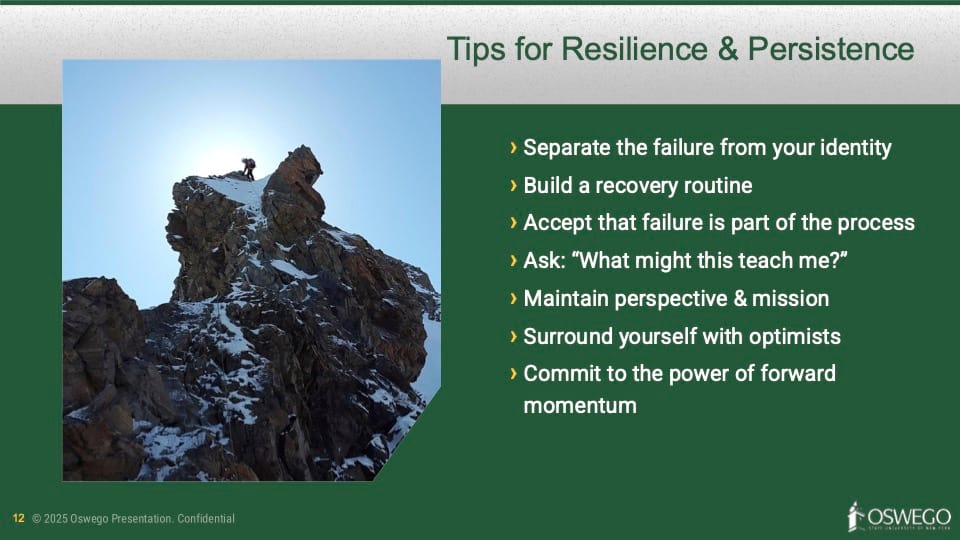
Here are my tips for being resilient and persistent.
As the founder of my company, when we failed our customers due to this defect, I felt that failure personally. But I also knew that moving forward meant separating the failure from my personal identity. This separation is critical: it is a failure in my product, not me.
It is helpful to have a recovery routine - a ritual such as exercising or journaling or going for a walk. For me, I liked to hyper focus on the people around me - understanding what they needed, and how best I could support and motivate them as we worked toward a solution.
It’s also helpful to zoom out: to step back from the details of the issue and remind yourself of the big picture. I knew the product idea I had been told years earlier was a “really really bad idea” was in fact a real business. Could this failure cause our customers to leave us? Absolutely. But the day after they cancelled their contracts, I knew they would still need to find a solution to the problems we had solved.
And lastly is the incredible power of forward momentum. Pushing through failure almost always requires taking a step forward - no matter how small - and then showing up tomorrow to do it again. When you string together enough small steps, eventually you will have the momentum required to push through a failure.
Failure doesn’t make you a bad person. But more often than not, it can make you a better one.
CloudHealth: From Start To Exit
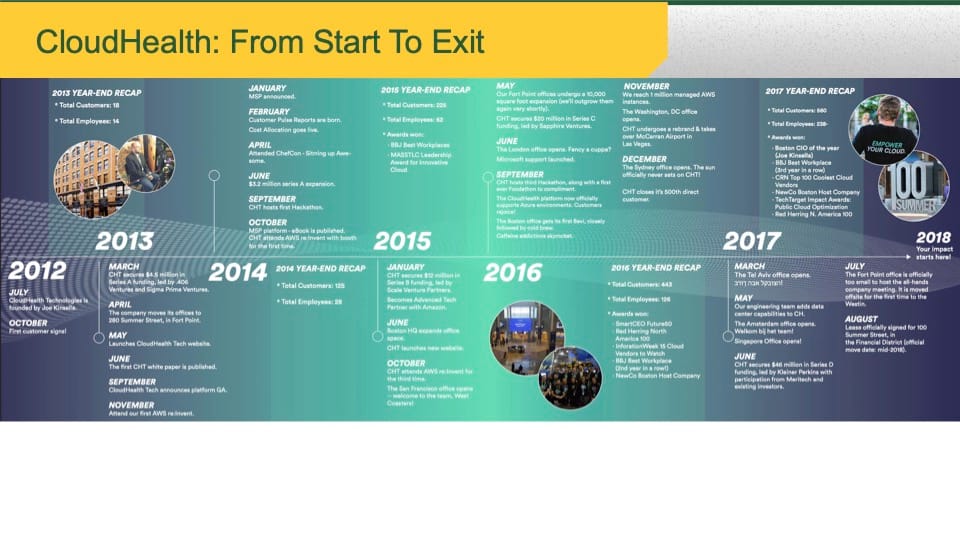
The story book version of CloudHealth is that we became one of the fastest growing companies in Boston, created a new product category, and grew to over 500 people. But as you’ve heard today, the real story is far messier - and also far more interesting. We struggled, failed, innovated and persevered every step of the way. Like all startups, we got some things right and some things wrong. If there was a secret to our success, it was this: hire great people, find great customers, strive to drive customer value every day, be humble, persevere through failure, and hope to catch a few lucky breaks along the way. But all of this was only possible because we had already committed ourselves to an entrepreneurial mindset, and to surrounding ourselves with likeminded people who were willing to keep pushing forward even when when the outcome was highly uncertain.
Thank you.